Welding careers overview
A welding career typically moves through three stages: an entry credential that proves general skill, a code-specific qualification tied to the work an employer actually does, and, for some welders, a move into inspection. The U.S. Bureau of Labor Statistics reports a median annual wage of $53,750 (BLS OEWS, May 2025) for welders, cutters, solderers, and brazers, with about 45,600 projected annual openings from 2024 to 2034.
What a welder actually does, day to day
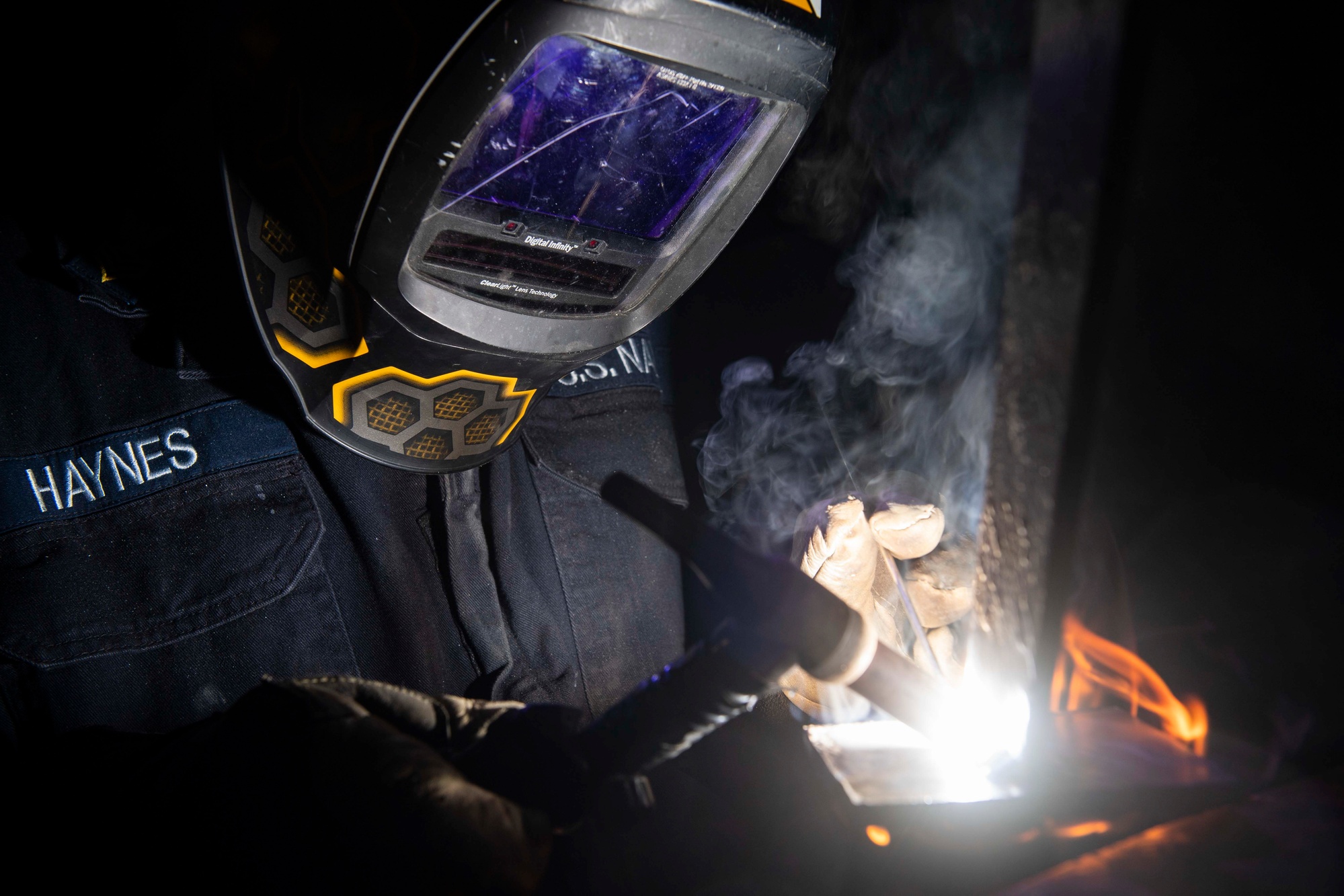
A welder joins pieces of metal by melting and fusing them, following a written procedure or blueprint that specifies the joint, the material, and the process to use. The work starts before the torch or gun ever fires: reading blueprints and specifications, laying out the joint, and confirming the base material and thickness match what the job calls for. From there, the core tasks are consistent across most welding jobs:
- Select the process. MIG, TIG, or stick, chosen based on the material, joint type, and working conditions; see MIG vs. TIG vs. stick for how the three compare.
- Set up equipment. Configure the machine, select filler metal, and prepare the joint surface.
- Run the weld. Execute the joint according to the specified procedure, controlling heat, travel speed, and technique.
- Inspect the result. Check the finished weld against the applicable code or specification, visually or with basic gauges, before signing off.
That inspect-the-result step is not optional. A weld that looks fine but does not meet the code's dimensional or strength requirements gets reworked or rejected, which is why blueprint reading and code familiarity matter as much as torch control. Most welding jobs are governed by a written procedure specification tied to a code that applies to the industry: structural steel, pipeline, and sheet metal fabrication each have their own governing codes and tolerances for what counts as an acceptable weld.
Where welders work, and the safety practices the job requires
BLS's Occupational Outlook Handbook names manufacturing and construction among the sectors that employ welders, cutters, solderers, and brazers, alongside other production and repair settings. Conditions vary by setting: a shop floor, a construction site, a shipyard, or a pipeline right-of-way each impose different demands, from working in cramped spaces to overhead welding to outdoor conditions.
Welding produces intense light, heat, fumes, and sparks, so safety practice is built into the job rather than an optional add-on. Standard practices include personal protective equipment (a welding helmet with the correct shade lens, flame-resistant clothing, and gloves), ventilation to clear welding fume from the breathing zone, and fire and spark control, including clearing flammable material from the work area. These practices apply across MIG, TIG, and stick welding, though the specific hazards shift with the process and setting.
Skills the job draws on
Beyond running a clean bead, the job draws on blueprint and specification reading, basic metallurgy (knowing how a base metal and filler metal behave together), math for measurements and joint angles, and enough procedural discipline to follow a written welding procedure exactly, since deviating from it can mean the weld no longer meets the code it was qualified against. Welding training programs generally combine hands-on booth time across MIG, TIG, and stick with blueprint reading and safety instruction, though programs vary in which processes they emphasize and how much hands-on time they provide; check a program's curriculum on the state directory before enrolling.
Stage 1: Entry credential
AWS Certified Welder (CW) is the credential most job postings mean by "certified welder." It has no prerequisites and tests a specific process and position at an AWS Accredited Test Facility. See the AWS CW page for cost and test format.
Stage 2: Code-specific specialty
Employers qualify welders against the specific code their work requires. Job postings name these codes directly:
- AWS D1.1: Structural Welding Code: Steel
- AWS D1.2: Structural Welding Code: Aluminum
- AWS D1.3: Structural Welding Code: Sheet Steel
- AWS D1.5: Bridge Welding Code
- AWS D1.6: Structural Welding Code: Stainless Steel
- AWS D1.8: Structural Welding Code: Seismic Supplement
Structural steel work (D1.1) is one of the most commonly referenced codes in general fabrication and construction postings; the others apply to specific materials or structure types, such as aluminum (D1.2) or bridges (D1.5).
Stage 3: Inspection
Some welders move from producing welds to inspecting them, usually through the AWS Certified Welding Inspector (CWI) credential. CWI has education-and-experience prerequisites (as little as one year with a relevant bachelor's degree, more with less formal education) and a three-part exam. It is the standard credential named in quality-control and code-compliance job postings. See what a welding inspector does and makes for more detail.
A note on ASME and state-licensed work
Pressure-vessel and boiler fabrication run on a different qualification model: ASME qualifications are issued by the employer under its own quality program, not by ASME to the individual welder, so there is no public registry to search. Some states and major cities also license boiler and pressure-vessel work directly; exactly which ones, and under what rules, changes over time and isn't something we've verified against a current, authoritative source, so confirm the current list with your state board rather than treating any specific jurisdiction named elsewhere as settled. See the certification codex for the full explanation.
Ready to find training or a first employer? Start with welding programs by state or local welding shops by metro.